Portfolio

Our footprint across Metro Vancouver

Years of inspections across Metro Vancouver's houses, towers and commercial buildings — we know the building stock, its construction eras and its typical failure points.

North VancouverNorth VanWest VancouverWest VanVancouverVancouverCoquitlamBurnabyBurnabyPort CoquitlamMaple RidgeLangleyLangleyPort MoodySurreySurreyRichmondRichmondNew WestminsterAnmoreWhite RockDeltaPitt MeadowsSquamish / Sea-to-SkyBurrard InletEnglish BayFraser RiverBoundary BayPitt RiverNorth Shore mountains
Each area of colour represents completed inspections · locations approximateFewer → More inspectionsNot to scale

How we report

Observations. Implications. Action.

Powered by SmartDify
Building condition reportAnonymized evidence showcase
FINDINGS OVERVIEW

Evidence, prioritised.

Record-wide shares; the examples below are illustrative classifications, not one property's results.

  • Safety 23%
  • Major 34%
  • Minor 43%
  • Site, grading & drainage18%
  • Interior18%
  • Exterior envelope13%
  • Electrical10%
  • Plumbing7%
  • Roof7%
  • Life safety6%

Documented findings

Electrical

Observation / Implication / Recommendation
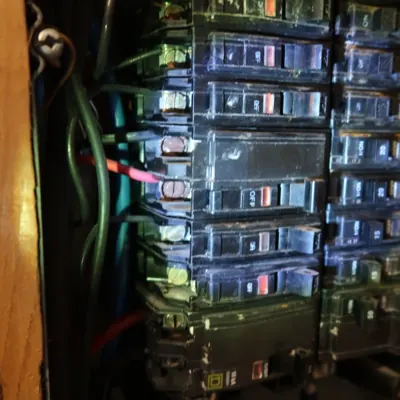
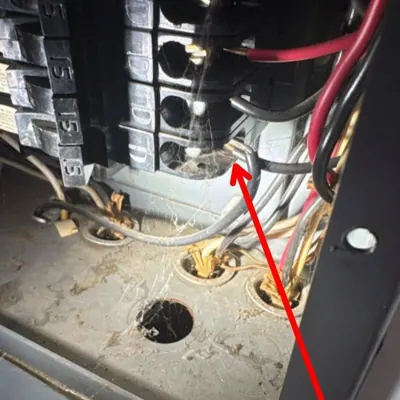
Double-tapped circuit breaker terminal
SafetyMain panel

Double-tapped breaker terminal

Observation
Multiple conductors are documented at a circuit-breaker terminal.
Implication
Uneven clamping at a terminal not rated for multiple conductors can cause resistive heating and increase fire risk.
Recommendation
Have the terminal rating verified and the connection corrected as required. Do not disturb energised equipment.
Corrosion inside electrical panel
MajorElectrical panel

Corrosion inside electrical panel

Observation
Corrosion is documented within the electrical panel.
Implication
Moisture-driven corrosion can degrade connections and the protective enclosure.
Recommendation
Have a licensed electrician assess the components and investigate the moisture source; do not disturb energised equipment.
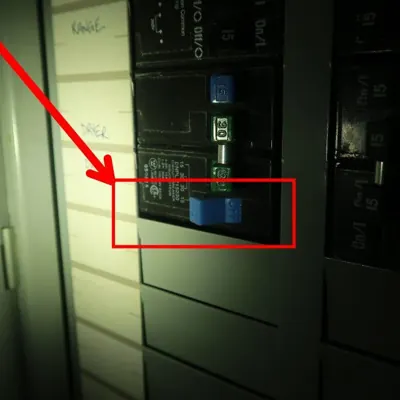
Panel safety barrier deficiency
SafetyPanel barrier

Panel safety barrier deficiency

Observation
The annotated panel evidence identifies a deficient protective barrier.
Implication
Deficient barriers can expose normally inaccessible electrical parts to accidental contact.
Recommendation
Restrict access and have a licensed electrician verify and restore the required protective barrier.

Attic

Observation / Implication / Recommendation
Suspected attic surface growth
MajorAttic

Possible attic fungal growth

Observation
Possible surface growth is visible on attic material; appearance alone does not identify mould or species.
Implication
Persistent moisture can deteriorate timber and insulation and affect indoor air quality.
Recommendation
Investigate moisture sources and ventilation. Confirm material condition and arrange appropriate assessment before remediation.
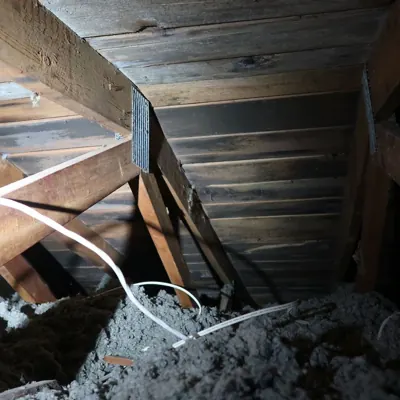
Attic active moisture intrusion
MajorAttic roof framing

Attic moisture intrusion

Observation
The inspection evidence documents moisture intrusion at attic roof materials.
Implication
Water entry can wet insulation and timber, reducing thermal performance and promoting deterioration.
Recommendation
Trace the water-entry pathway, verify moisture extent and repair the source before drying affected materials.
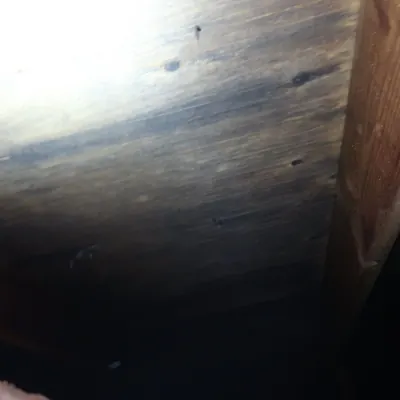
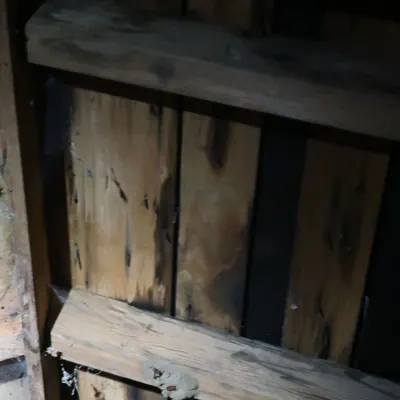
Localised attic moisture staining
MinorAttic framing

Localised moisture staining

Observation
Localised staining is visible on attic timber; the image does not establish whether wetting remains active.
Implication
Staining records a moisture pathway that requires comparison with current moisture measurements.
Recommendation
Measure moisture at the stained area and monitor after rainfall; escalate repairs if active wetting is confirmed.
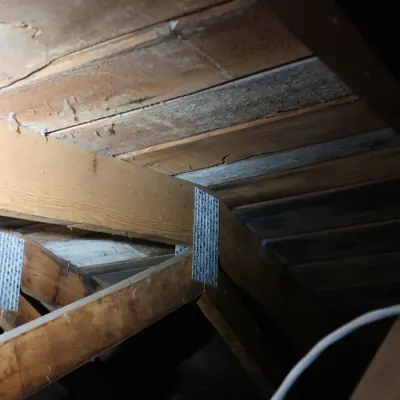
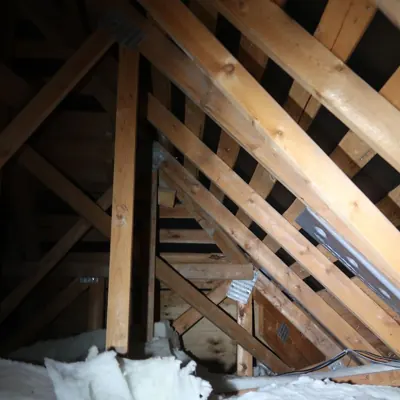
Uneven attic insulation distribution
MinorAttic insulation

Uneven insulation distribution

Observation
Thin and displaced insulation is visible in the accessible attic.
Implication
Uneven insulation increases local heat transfer and can leave colder surfaces susceptible to condensation.
Recommendation
Redistribute or supplement insulation while maintaining ventilation clearances and access to electrical equipment.

Roof

Observation / Implication / Recommendation
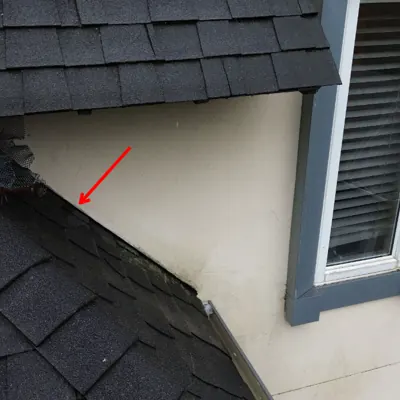
Missing stepped flashing interface
MajorRoof-to-wall junction

Missing roof step flashing

Observation
Missing step flashing is documented at a roof-to-wall junction.
Implication
Interrupted overlapping drainage increases water-entry risk and can damage concealed envelope materials.
Recommendation
Have the roof-to-wall weatherproofing reviewed and correctly installed; investigate affected materials.
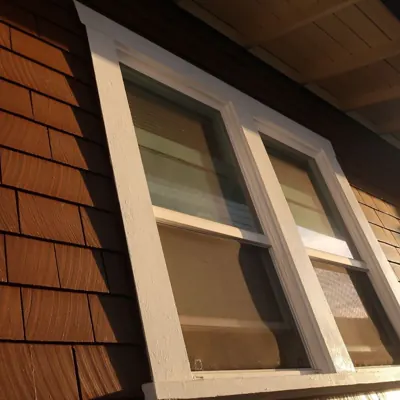
Missing soffit ventilation opening
MajorEave / soffit

Missing soffit ventilation opening

Observation
The inspection record identifies a missing ventilation opening at the soffit.
Implication
Reduced eave ventilation can limit attic air exchange and contribute to condensation under suitable humidity conditions.
Recommendation
Have ventilation continuity and intake provision reviewed before installing suitable openings.

Structure & Foundation

Observation / Implication / Recommendation
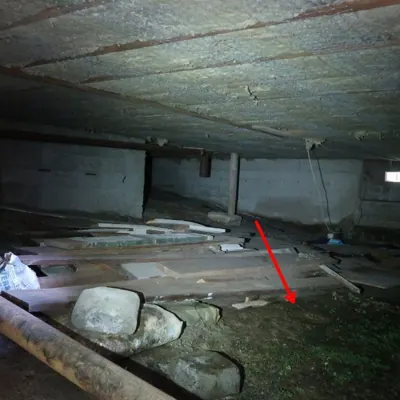
Standing water in crawl space
MajorCrawlspace

Standing water in crawlspace

Observation
Standing water is documented on the crawlspace floor.
Implication
Persistent water can wet accessible materials, promote deterioration and increase moisture loading on the building.
Recommendation
Investigate the water-entry source and drainage. Assess affected materials before repair and drying.

Heating & Ventilation

Observation / Implication / Recommendation
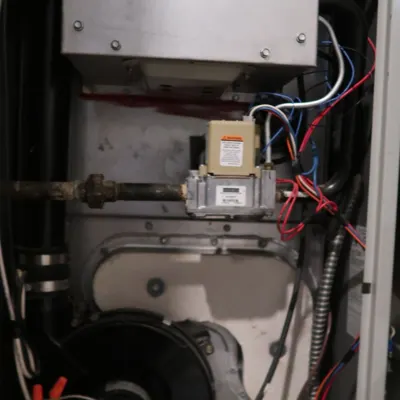
Aged furnace combustion assembly
MajorHeating equipment

Furnace at expected service-life limit

Observation
The supplied inspection record identifies a furnace at the end of its expected service life; the accessible combustion assembly is documented. A photograph alone does not establish remaining life.
Implication
Ageing equipment can reduce efficiency and increase maintenance costs; combustion faults may create carbon-monoxide exposure, so combustion safety requires testing rather than inference from age. Replacement budgeting is warranted.
Recommendation
Arrange operating, venting and combustion-safety assessment, verify equipment age and condition, and plan repair or replacement as advised.
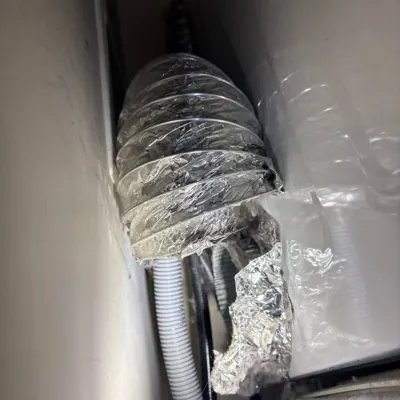
Damaged dryer vent connection
SafetyDryer exhaust

Damaged dryer vent connection

Observation
A damaged exhaust connection is visible at the dryer duct.
Implication
Escaping lint and humid exhaust can accumulate in concealed spaces, increasing condensation and fire risk.
Recommendation
Have the connection repaired with suitable exhaust ducting and the vent path cleaned and checked.
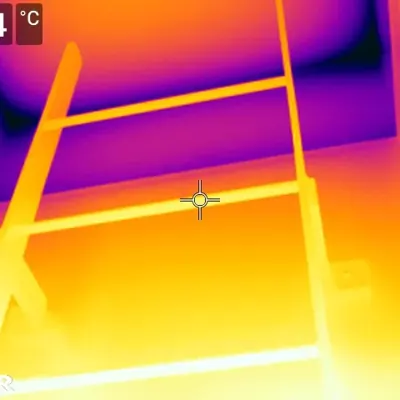
Air leakage at roof access hatchΔT 18.2 °C
Roof-access hatch · infrared
Attic water-entry pathway
Related attic visual evidence
Envelope · thermal assessment

Air leakage at access hatch

Cold hatch surfaces reach 1.2 °C against a reported 19.4 °C interior reference.

The pattern indicates an unsealed hatch or thermal bypass; improve gasketing and insulation.

ΔT compares the recorded hatch and interior reference. The visual image is a separate attic example, not a matched capture. Surface-temperature patterns do not establish moisture; verify suspected wetness with a moisture meter.

Recommended specialist · envelope / insulation contractor
  1. On-site capture
  2. EvidencePhoto, meter, thermal
  3. Classification
  4. Report delivered

Assets

Saeed Farmahin Farahani, PhD

Since 2018

In the property inspection industry.

Architecture background

Architecture education and professional practice: building design, multi-discipline coordination and construction management on residential, commercial and high-rise projects.

SR&ED approved

Approved by the Canada Revenue Agency (CRA) for SR&ED - scientific research in AI-driven inspection technology.

Consumer Protection BC

Licensed by Consumer Protection BC · Licence #82272

ITC Level I

Certified Thermographer.

BCIT House Inspection

Building Code Part 9 and Building Envelope.

Carson Dunlop

Commercial Property Inspection (ASTM E2018).

Smartinspection.ca®

Registered trademark in Canada.

Buildex Vancouver

Exhibitor.

Peer-reviewed research in healthy buildings, indoor environment and architecture · 27 citations (Google Scholar)

  1. 2013
    Geometry in pre-Islamic Iranian architecture and its manifestation in contemporary Iranian architecture

    K. Daneshjoo, S. Farmahin Farahani

    Journal of Basic Studies and New Technologies in Architecture & Planning (Tarbiat Modares University, bsnt.modares.ac.ir)

    Cited by 26Architecture & geometry
  2. 2011
    Role of toilet type in transmission of infections

    M. Mahdavinejad, M. Bemanian, S. Farmahin Farahani, A. Tajik

    Academic Research International 1(2), 110

    Cited by 18Healthy buildings / hygiene
  3. 2012
    The cross-cultural interaction between the art of garden design of old cities of Iran and India along the Silk Road

    M.R. Pourjafar, M. Mahdavinejad, M. Shamshirband, S. Farmahin Farahani, et al.

    Proceedings of the 2nd International Conference, Mukogawa Women's University

    Cited by 5Architecture & landscape
  4. 2011
    Association of mental health and work environment in hospital workers

    M. Mahdavinejad, M. Bemanian, S. Farmahin Farahani, A. Tajik, P. Taghavi

    International Journal of Academic Research 3(1)

    Cited by 4Healthy buildings / indoor environment

Technical articles · InspectionCore

Inspection evidence

Request an inspection quote

Request a quote